
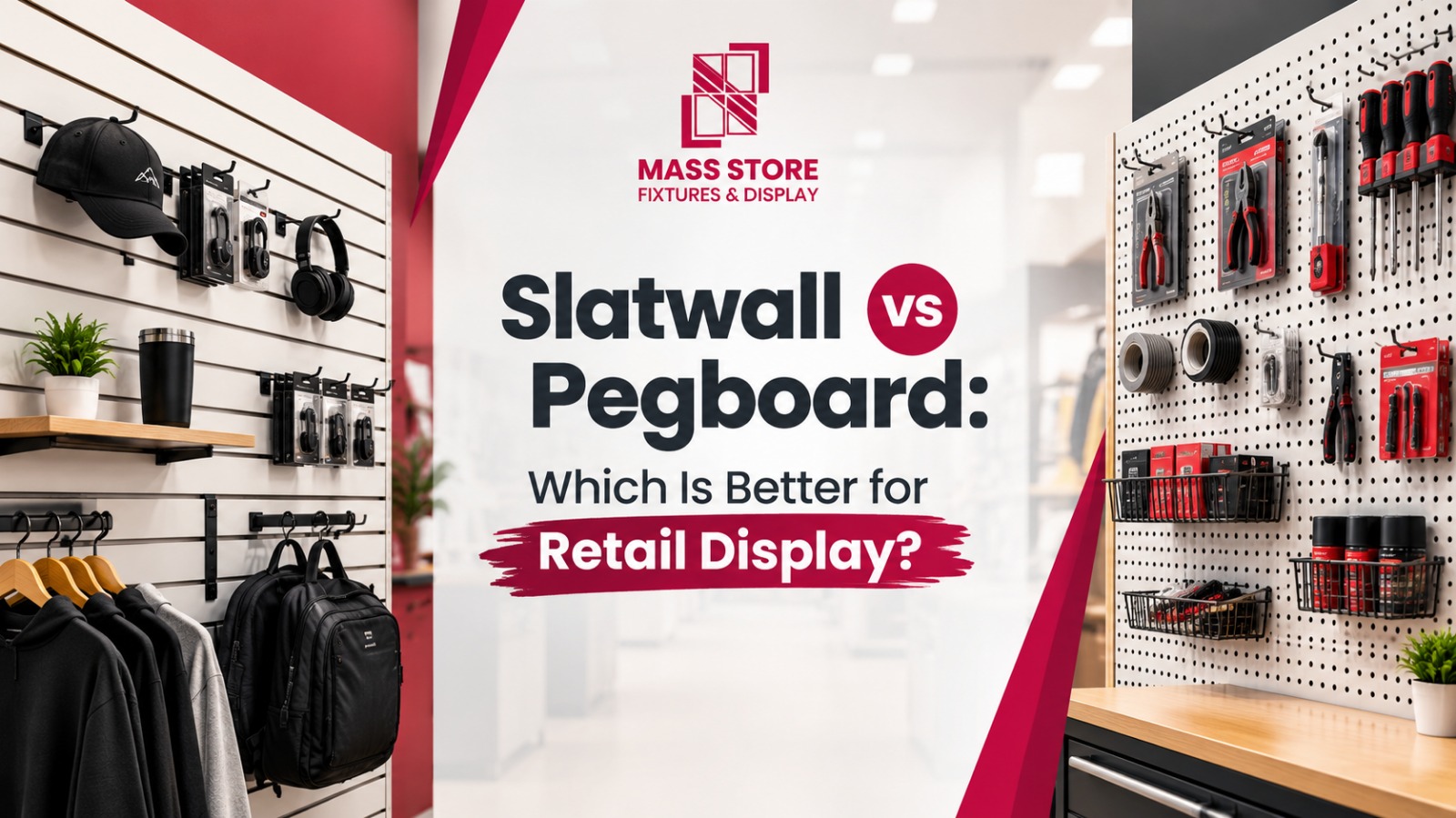
Meta title: Slatwall vs Pegboard for Retail Display: Full Comparison Guide Meta description: Comparing slatwall and pegboard for your retail store? See real weight capacity, cost, durability, and appearance data before you buy.
If you are setting up or refreshing a retail store, one of the first fixture decisions you will face is the wall system itself. Two names come up again and again: slat wall and pegboard. Both let you hang hooks, shelves, and merchandise. Both mount to almost any wall. But they are not interchangeable, and picking the wrong one can quietly cost you sales, staff time, or a professional look you can never quite get back.
This guide breaks down slat wall panels and pegboard side by side, using real specifications rather than marketing language, so you can match the fixture to your store instead of the other way around.
What Is Slatwall?
Slat wall, also written as slatwall or slat panels, is a wall covering made from horizontal grooved boards. The grooves run 3 inches apart on center in most standard panels, which is the industry norm, though 6 inch spacing is also available for a more minimal, shiplap style look. Hooks, brackets, and shelf brackets slide directly into these grooves and lock into place, so nothing is resting loosely in a hole.
Standard slatwall panels come in 4 foot by 8 foot sheets, and can be installed horizontally or vertically depending on the layout you need. Core materials include:
- MDF (medium density fiberboard), the most common and most affordable core
- PVC, which resists moisture and holds up better in humid or high traffic environments
- Metal, used where maximum durability and load bearing matter most
Slat wall panels are finished in a wide range of decorative surfaces, including wood tones, marble and stone look laminates, matte colors, and textured 3D patterns, which is part of why this system has become the default for boutique retail, showrooms, and brand focused store design.
What Is Pegboard?
Pegboard is a flat board, traditionally hardboard, drilled with a uniform grid of round holes, usually spaced 1 inch apart. Hooks and pegs are inserted directly into the holes to hold merchandise or tools. It has been a fixture in hardware stores, workshops, and garages for decades because it is cheap, simple, and instantly recognizable.
Pegboard is sold in a few common materials:
- Hardboard (the classic brown pegboard), the lowest cost option but the least moisture resistant
- Metal pegboard, stronger and more durable, at a higher price point
- Plastic pegboard, lightweight and moisture resistant but limited in weight capacity
Slatwall vs Pegboard: Full Comparison Table
| Attribute | Slatwall | Pegboard |
|---|---|---|
| Weight capacity per hook | 20 to 75 lbs, depending on panel core and accessory, with heavy duty PVC rated up to 75 to 100 lbs per square foot | Roughly 5 to 25 lbs per hook on standard hardboard, up to around 200 lbs total panel load on heavy duty metal pegboard |
| Hook stability | Locks into the groove and will not fall out or shift during handling | Rests in a drilled hole and can dislodge or loosen with repeated use |
| Moisture resistance | High, especially PVC and metal cores, which will not warp or swell | Low for hardboard, which absorbs moisture and can sag or rot over time |
| Reconfiguration | Slide and reposition accessories in seconds, no tools or new holes needed | Pegs must be lifted out and reinserted, and repeated repositioning wears out the holes |
| Appearance | Sleek, finished, showroom quality look in wood, marble, matte, and textured finishes | Utilitarian look with visible drilled holes, better suited to workshop or stockroom settings |
| Panel material options | MDF, PVC, metal | Hardboard, metal, plastic |
| Typical panel cost | Higher upfront, generally $20 to 40 or more per 4×8 panel depending on core and finish | Lower upfront, generally $10 to 20 per 4×8 sheet |
| Accessory ecosystem | Large and purpose built for retail: hooks, shelves, bins, gondola inserts, brackets | Moderate, mostly basic hooks and small shelf brackets |
| Best suited for | Boutique retail, apparel, cosmetics, electronics displays, showrooms, brand focused storefronts | Hardware stores, workshops, stockrooms, budget tool storage |
Slatwall: Pros and Cons
Pros
- Hooks and shelves lock securely into the groove, so displays stay in place even when customers browse and handle merchandise throughout the day
- Higher weight capacity supports heavier product categories such as bags, tools, or bulk merchandise without sagging
- PVC and metal core panels resist moisture, which matters in stores with high foot traffic, entryway humidity, or seasonal weather exposure
- Decorative finishes such as wood grain, marble look, matte, and textured 3D patterns let the wall itself contribute to your store’s visual identity instead of just functioning as backdrop
- Merchandising layouts can be changed in minutes, which is valuable for stores that rotate seasonal displays, promotions, or new arrivals often
Cons
- Higher upfront cost per panel compared to standard pegboard
- Installation typically calls for stud mounting and, for heavier duty ratings, fastening into studs at consistent intervals rather than only at the panel edges
- Not necessary for very low budget or purely functional storage where appearance is not a priority
Pegboard: Pros and Cons
Pros
- Lowest upfront material cost of any wall storage system, which makes it attractive for tight budgets or temporary setups
- Widely available and simple to install, often requiring only basic tools
- Familiar, recognizable format that customers and staff already know how to use
- Works fine for light, uniform items such as small tools or accessories where weight is not a concern
Cons
- Weight capacity is limited, and standard hardboard pegboard is best kept under roughly 25 lbs per hook before hooks start to loosen or the board begins to sag
- Hardboard pegboard is vulnerable to moisture and can warp, swell, or degrade in humid conditions
- The visible drilled hole pattern reads as utilitarian rather than retail polished, which can undercut a store’s presentation
- Repeated repositioning wears out the holes over time, loosening hook fit
- The accessory range is narrower than slatwall, limiting how creative a merchandising layout can get
Weight Capacity: The Numbers That Actually Matter
Weight capacity is usually the deciding factor once a store owner moves past appearance, so it is worth being precise about it.
Standard hardboard pegboard is generally rated for light loads, roughly 5 to 25 lbs per hook. That is enough for small accessories, jewelry, or lightweight retail items, but it reaches its limit quickly with anything heavier. Metal pegboard performs better and can handle more, with some heavy duty metal systems rated up to around 200 lbs across a full panel, but it comes at a higher price than hardboard.
Slatwall spreads the load differently. Because hooks lock into a continuous horizontal groove rather than a single drilled hole, the weight is distributed across the panel structure instead of concentrated at one point. MDF core slatwall typically supports around 10 to 20 lbs per bracket, while PVC core slatwall can support 50 to 75 lbs per bracket, and heavy duty solid core PVC panels are often rated at 75 to 100 lbs per square foot of panel when properly fastened into wall studs at regular intervals.
For retail displays carrying apparel, bags, footwear, electronics, or anything beyond very light accessories, that gap in load bearing capacity is the practical reason most decision stage buyers choose slat wall over pegboard.
Who Should Choose Slatwall for Retail Display
Slat wall panels are the stronger fit for stores where the wall itself is part of the customer experience and where product weight varies. This includes:
- Boutique apparel and footwear stores that want a polished, showroom quality backdrop
- Cosmetics, accessories, and electronics retailers displaying a mix of light and moderately heavy items
- Stores that rotate merchandising layouts seasonally or for promotions and need fast, tool free reconfiguration
- Multi location retail brands that want a consistent, professional look across every storefront
- Any commercial space where the wall doubles as branding, not just storage
Who Should Choose Pegboard for Retail Display
Pegboard still has a place, mostly outside of customer facing sales floors:
- Hardware stores and workshops where function outweighs appearance
- Backroom or stockroom organization where visible drilled holes are not a concern
- Very tight budget setups or short term, temporary displays
- Light, uniform product categories where weight capacity is not a limiting factor
Frequently Asked Questions
Is slatwall stronger than pegboard?
Yes, in most direct comparisons. Slatwall, particularly PVC and metal core panels, distributes weight across a continuous groove and generally outperforms standard hardboard pegboard, which concentrates load on individual drilled holes.
Is slatwall more expensive than pegboard?
Slat wall panels typically cost more per sheet than standard hardboard pegboard, largely due to the decorative finishes, groove milling, and stronger core materials. For a retail environment, most stores find the difference in appearance, durability, and reconfiguration speed justifies the added cost.
Can slatwall hold heavy retail merchandise?
Yes. PVC and metal core slat wall panels are built to carry substantially more weight than hardboard pegboard, making them suitable for apparel, bags, footwear, tools, and other moderately heavy retail merchandise, provided the panel is properly mounted into wall studs.
What is the standard slatwall groove spacing?
Most slat wall panels use 3 inch on center groove spacing, which is the industry standard and compatible with the widest range of hooks, shelves, and brackets. A 6 inch spacing option is also available for a more minimal, streamlined appearance.
Do I need a professional to install slatwall panels?
Basic installation can be handled by a store owner or general contractor comfortable with stud mounting. For heavier duty load ratings, panels should be fastened into studs at consistent intervals, not only along the edges, to reach their full rated capacity.
Choosing the Right Slatwall Finish for Your Store
If slat wall is the right fit for your retail space, the next decision is finish and material rather than the panel type itself. Options generally fall into a few categories: solid colors such as matte white or matte black for a clean, minimal look, wood tone and rustic finishes for a warm, natural feel, marble and stone look laminates for an upscale boutique presentation, and textured 3D panels for a more tactile, dimensional feature wall. Each finish performs the same functionally, so the choice usually comes down to how the wall should read alongside your merchandising and brand.
The Bottom Line
Pegboard is inexpensive and simple, and it still earns its place in workshops, stockrooms, and tight budget setups. But for a retail sales floor, slat wall is generally the better system. It holds more weight, resists moisture, reconfigures faster, and looks like it belongs in a professional retail environment rather than a garage. If your store is customer facing and your wall needs to do double duty as both storage and visual merchandising, slatwall is the fixture built for that job.
Ready to see the full range of decorative slat wall panels available for your store? Browse our complete slatwall collection to compare finishes, materials, and pricing side by side.