
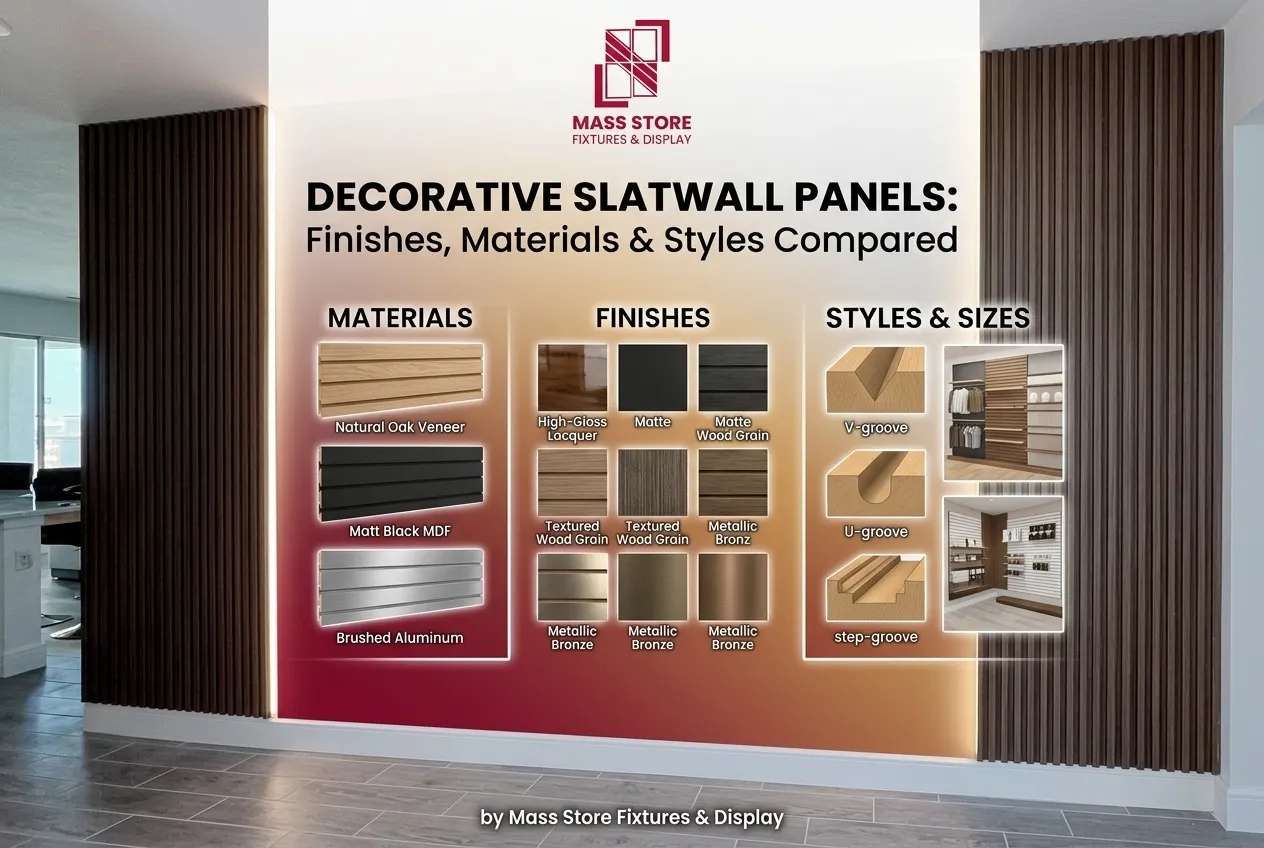
If you have ever walked into a boutique, a garage showroom, or a salon and noticed a wall doing double duty as both décor and display, chances are you were looking at slatwall. It is one of the most widely used display systems in retail and commercial design, and for good reason. Slatwall turns flat, wasted wall space into flexible, revenue-generating real estate, all while looking sharp enough to double as a design feature.
But not all slatwall is created equal. The material, finish, and groove style you choose will affect everything from durability and weight capacity to installation cost and how well the panels hold up in your specific environment. This guide breaks down the real differences between slatwall materials and finishes, what they cost, and which option makes sense for different industries, so you can make a decision based on facts rather than guesswork.
What Is Slatwall, Exactly?
Slatwall is a wall panel system made up of horizontal (or sometimes vertical) grooves spaced a few inches apart, designed to accept hooks, brackets, shelves, and other display accessories. Unlike pegboard, which relies on small holes and thin hardware, slatwall uses interlocking horizontal channels that distribute weight more evenly and hold merchandise more securely.
Slatwall panels are typically built from a rigid core wrapped in a decorative surface layer, and they can be mounted directly to a wall, framed into a fixture, or built into gondola and showcase units. Because the groove spacing is standardized, accessories can be swapped, repositioned, or rearranged in minutes without any new drilling or hardware.
Why It Matters: Slatwall Is Not Just a Display Tool
Slatwall’s popularity is not just a trend. It shows up repeatedly in retail performance data because it solves a real business problem: how to display more product, more attractively, in less space, without a full remodel every time inventory changes.
A few figures worth knowing:
- Specialty retail trade in the US, one of the largest users of slatwall systems, generated over $700 billion in annual sales as of 2023, and demand for modular, quickly reconfigurable wall display systems has grown alongside it.
- The slat wall panel market is projected to grow at a CAGR of roughly 6.0% from 2026 to 2033, driven largely by specialty retail, franchise rollouts, and the shift toward experience-focused physical stores.
- Metal slatwall, the fastest-growing material segment, is expanding at an estimated 8.1% CAGR through 2033 as more industries move toward heavier-duty, moisture-resistant display systems.
- Retailers with organized, well-planned merchandising layouts have reported conversion rate increases of around 15% compared to stores with cluttered or disorganized displays, and customer engagement gains of roughly 20% when slatwall and similar fixtures are used to showcase merchandise clearly.
- A large majority of shoppers, close to 75% in consumer surveys, say they view a brand more positively when its retail space looks organized and well-presented.
None of that happens by accident. It happens because slatwall lets a business control sightlines, group products logically, and put higher-margin or impulse items at eye level, then change all of it again next season without tearing anything out.
Slatwall Materials Compared
The core material of a slatwall panel determines its strength, weight capacity, moisture resistance, and how it should be used. Here is how the main options stack up.
MDF (Medium-Density Fiberboard)
MDF is the most common slatwall substrate, and it is the default choice for most retail interiors.
- Typical cost: roughly $50 to $130 per 4×8 ft panel, depending on finish
- Strengths: smooth surface, easy to paint or laminate, consistent quality, widely available
- Weaknesses: vulnerable to moisture and humidity, heavier than plastic alternatives, not ideal for outdoor or damp environments
- Best for: apparel stores, boutiques, salons, offices, and any indoor retail environment where a clean, paintable surface matters more than moisture resistance
PVC and Plastic Slatwall
PVC slatwall panels are built for environments where moisture, humidity, or heavy cleaning are part of daily operations.
- Typical cost: roughly $90 to $150 per panel
- Strengths: waterproof, resistant to warping, easy to wipe down, holds up outdoors or in humid spaces
- Weaknesses: higher upfront cost than MDF, more limited finish variety
- Best for: garages, car washes, pool and spa retailers, outdoor kiosks, and healthcare or lab environments where sanitation is a priority
Metal Slatwall (Steel and Aluminum)
Metal is the fastest-growing category in the slatwall market, and it is increasingly the choice for businesses that need to display heavier or bulkier merchandise.
- Typical cost: roughly $120 to $250+ per panel, higher with metal groove inserts
- Weight capacity: metal slatwall systems typically support 100 to 150 lbs per hook without deflection, compared to considerably lower limits for MDF-only panels
- Strengths: superior durability, excellent moisture and pest resistance, supports heavy tools and equipment, compatible with integrated LED lighting for premium displays
- Weaknesses: highest material cost, heavier to install, less warmth in appearance than wood
- Best for: hardware stores, automotive accessory retailers, tool and equipment showrooms, and supermarkets, where humidity and heavy product weight rule out lighter materials
Wood Veneer and Solid Wood
For businesses where the wall itself is part of the brand experience, real wood veneer slatwall brings warmth and texture that laminate cannot fully replicate.
- Strengths: authentic grain patterns, premium look and feel, some acoustic dampening when backed with felt, works as both a display system and a design feature
- Weaknesses: highest material and finishing cost, more sensitive to humidity than metal or PVC unless properly sealed
- Best for: high-end boutiques, hospitality spaces, salons, wine and spirits retailers, and showrooms where the environment itself needs to feel upscale
Slatwall Finishes Compared
Once the core material is decided, the finish is what determines how the panel actually looks on the sales floor, and it can shift the price meaningfully.
| Finish Type | What It Is | Typical Cost Impact | Best Use Case |
|---|---|---|---|
| Unfinished (paint grade) | Raw MDF or particleboard, ready for custom paint | Included in base panel price | Brands with a specific custom color to match exactly |
| Basic melamine | Pre-finished in white, black, cherry, maple, or gray | Included in base panel price | Most standard retail buildouts |
| Laminate (HPL) | Durable high-pressure laminate surface | Moderate increase | High-traffic stores needing scratch resistance |
| Wood veneer | Real wood surface over an engineered core | +$20 to $60 per panel | Upscale boutiques, salons, hospitality |
| Textured/3D woodgrain | Embossed surface mimicking barnwood, oak, whitewash, or brick | +$20 to $60 per panel | Feature walls, lifestyle and home goods retail |
| High-gloss or custom color | Digitally printed or specialty coated finish | +$20 to $60 per panel | Brand-specific color matching, flagship stores |
Groove spacing is another variable worth knowing. Standard options are 3-inch, 6-inch, 8-inch, or 12-inch on-center grooves, with 3-inch spacing offering the most flexibility for smaller or lightweight items, and wider spacing suiting larger merchandise or a more minimal aesthetic. Custom groove patterns are also available for brands that want a fully bespoke look.
Slatwall vs. Pegboard: Why the Upgrade Matters
Businesses considering slatwall are often comparing it against pegboard, so it is worth being direct about the difference:
- Weight capacity: Slatwall, especially with metal inserts, supports significantly more weight than pegboard’s small hook-and-hole system.
- Stability: Slatwall accessories lock into horizontal channels and stay put. Pegboard hooks can wobble or pop out under load.
- Appearance: Slatwall reads as a finished design element. Pegboard reads as a stockroom or workshop tool wall.
- Reconfiguration: Both systems allow rearranging, but slatwall’s continuous grooves make large-scale layout changes faster and cleaner.
For a business investing in how its space looks and functions long-term, slatwall is almost always the stronger choice.
Slatwall by Industry: Where It Makes the Biggest Difference
Retail and Apparel
This is slatwall’s original home turf. Apparel stores use it to hang garments, display accessories, and build seasonal end-caps that can be swapped out in an afternoon. Melamine or laminate MDF panels in neutral tones are the standard here, keeping costs down while letting the merchandise do the talking.
Automotive and Tool Retail
Automotive accessory shops and tool retailers need panels that can carry real weight without sagging. Metal slatwall with reinforced inserts is built for exactly this, supporting up to 150 lbs per hook, which is essential when displaying power tools, car parts, or heavy hardware.
Salons, Spas, and Beauty
Salons often use slatwall not just for retail product displays but as an actual design feature, incorporating wood veneer or textured woodgrain panels into the overall interior aesthetic. Since these environments deal with humidity from washing stations, PVC or properly sealed wood veneer options are worth considering near wet areas.
Grocery and Supermarkets
Humidity control is a real challenge in grocery environments, which is part of why metal slatwall has become the standard in supermarket end-caps and promotional displays. It resists moisture, temperature swings, and heavy daily handling far better than MDF.
Home Improvement and Garage Organization
Textured woodgrain and metal slatwall have both found a home in premium garage organization systems and home improvement showrooms, where durability matters as much as appearance.
Hospitality, Offices, and Interior Design
Outside of pure retail, wood veneer slatwall is increasingly used as a decorative acoustic wall treatment in offices, restaurants, and hotel lobbies. With a felt-backed core, it can genuinely help absorb sound while still functioning as a display or feature wall, making it a dual-purpose investment for hospitality spaces.
How to Choose the Right Slatwall for Your Space
A few questions worth answering before ordering:
- What are you displaying, and how heavy is it? Light apparel and accessories work fine on MDF. Tools, automotive parts, or bulk goods call for metal.
- Is the space exposed to moisture or heavy cleaning? If so, PVC or metal will outlast MDF by a wide margin.
- Is the wall itself part of your brand experience? If customers are meant to notice the wall, wood veneer or textured 3D finishes earn their higher price tag.
- How often will the display change? Frequent resets favor standard groove spacing and simpler finishes that are easy to match and replace.
- What is the budget per linear foot of wall? Pricing can range from roughly $50 per panel for basic paint-grade MDF up to $250 or more for reinforced metal or premium wood veneer, so matching material to actual need keeps costs under control.
Get Slatwall Panels Built for Your Business
At Mass Fixtures & Signs, we design, fabricate, and install custom slatwall and display fixtures for retail stores, salons, automotive shops, and commercial spaces across Houston and beyond. Whether you need standard melamine panels for a straightforward buildout or a fully custom wood veneer feature wall, our team can help you choose the right material, finish, and layout for your space and your budget.
Get a free consultation or reach out on WhatsApp to start planning your fixture and display project today.